
Smart irrigation network
IoT soil, water, and weather sensing that tells farmers exactly when — and how much — to irrigate.
- Location
- Albania
- Status
- Planned
- Sector
- Agriculture
- Updated
- 10 October 2026
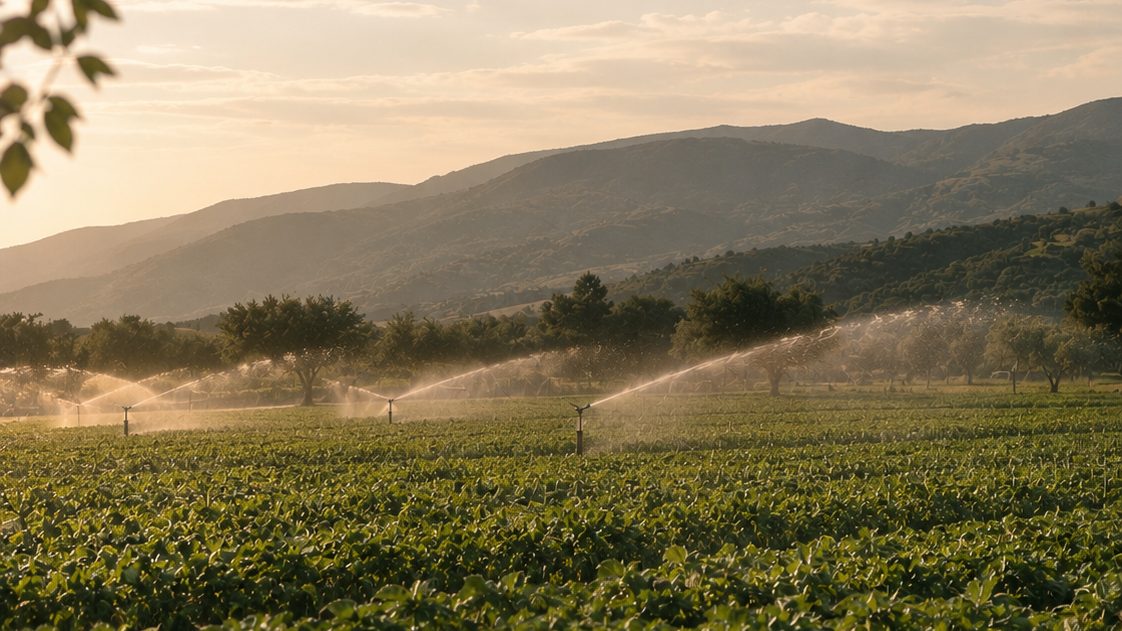
Reference design. This page describes how Greecon approaches this type of project and what we will measure. It is not a record of a delivered installation. The site, partners, and results will be published here once a project is confirmed.
The challenge
Irrigation by habit wastes water on some days and under-waters on others. Farmers can't see the root zone, so they irrigate on a calendar, by feel, or after the plant already shows stress. Leaks and clogged emitters go unnoticed until the harvest suffers.
Our approach
Sensing. Soil-moisture sensors at several depths in each irrigation zone, with temperature and EC where fertigation is used; a local weather station; flow meters and pressure sensors on the main line and at zone valves.
Local control. A site gateway runs the irrigation schedule and the safety interlocks — maximum runtime, minimum rest times, dry-run detection, and over-pressure cutoff — so the farm keeps working when the internet doesn't. See edge and cloud: why the control loop stays on site.
Decisions, not just data. The Greecon Platform combines soil readings, weather, and crop stage into a recommendation with a reason — for example, "Zone 3: irrigate tonight, about 40 minutes." — and lets the farmer confirm, adjust, or override. See from soil moisture to irrigation schedule.
Verification. Planned and delivered water are compared for every zone. Flow when a valve is closed, or less flow than expected, raises an alert for a leak or clogged emitters.
Energy. Where the farm has solar generation, pumping is scheduled for the hours the panels produce.
What we will measure
- Irrigation water applied per zone and season, against a baseline period or a comparison zone
- Yield and crop-quality indicators per zone
- Energy used per cubic metre pumped
- Leaks and faults detected, and time to fix
- Sensor data quality and availability
Phases
- Survey and baseline — soil mapping, an audit of the existing irrigation hardware, and a record of current water and energy use.
- Install and calibrate — sensor placement, flow and pressure metering, and gateway commissioning.
- Advisory mode — the system recommends; the farmer decides.
- Automatic control within agreed limits, after the recommendations have earned trust.
- Seasonal review — compare results with the baseline and tune.
Legal and compliance notes
- Confirm water-use rights and permits for the source before designing around it.
- Agree data ownership, use, and retention in the contract; data about an individual farmer may be personal data. See personal data on an IoT platform.
- Define responsibilities for operation and safety in the service agreement. See contracting for connected infrastructure.
Communication
Training for farmers and operators, an interface in Albanian and English, and short seasonal reports showing water used, energy used, and what changed. See what a farmer needs to see.