
Wastewater reuse monitoring
Automated treatment and real-time monitoring so treated water can be safely reused.
- Location
- Albania
- Status
- Planned
- Sector
- Water
- Updated
- 10 October 2026
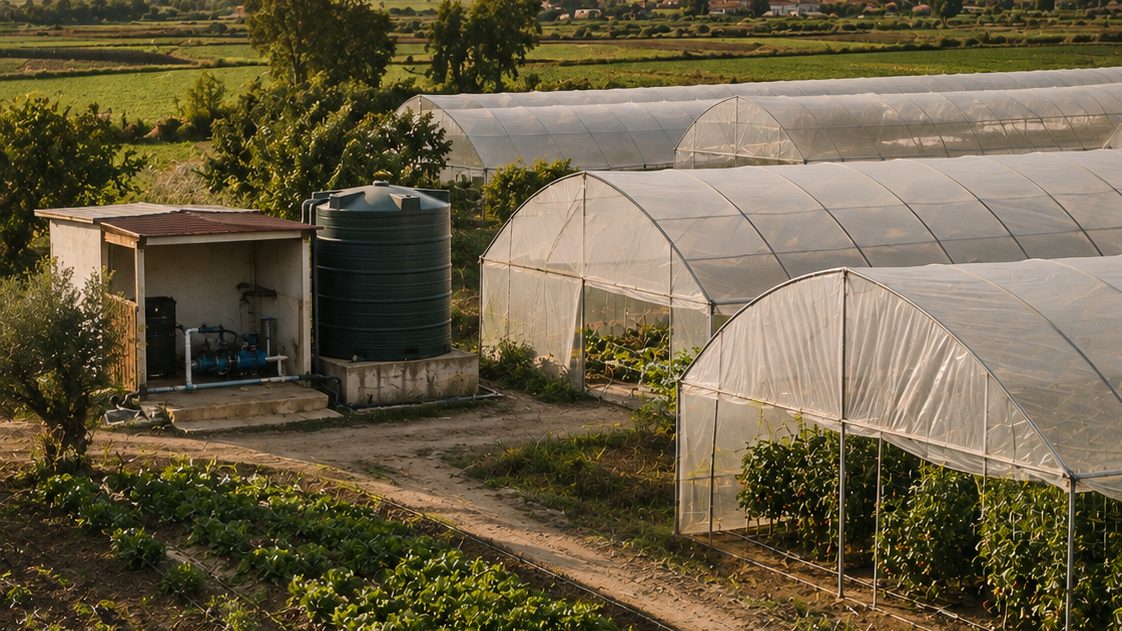
Reference design. This page describes how Greecon approaches this type of project and what we will measure. It is not a record of a delivered installation. The site, partners, and results will be published here once a project is confirmed.
The challenge
Cities and industries need to recycle more water, but treatment plants are often run without real-time visibility. Reuse adds a harder requirement: the water must be demonstrably safe every day, and the people using it must be able to see that.
Our approach
A treatment train. Compact biological treatment, filtration, and chemical-free UV disinfection, followed by storage and distribution for non-potable use such as irrigation.
Continuous monitoring. Flow, level, pressure, turbidity, UV transmittance, lamp status, filter pressure drop, pH, and temperature feed the Greecon Platform in real time. Laboratory results are recorded against the same timeline, because online sensors complement microbiological testing and do not replace it.
Fail to no-reuse. If a quality limit is exceeded, a lamp faults, or a key sensor becomes unreliable, a diverter sends water to a non-reuse path and an alarm is raised. Reuse resumes only after conditions have been back in range for a defined time. The decision happens at the edge, on site. See the engineering of safe reuse.
Automation. Treatment cycles and pumping are adjusted automatically within safe limits to keep quality on target while reducing energy use.
What we will measure
- Volume of wastewater treated and volume reused
- Compliance rate against the quality limits that apply, across all samples
- Number and duration of diversions, and their causes
- Energy used per cubic metre
- Availability of the plant and of its monitoring
Phases
- Study — flows, loads, intended uses, and the regulatory path for permits and quality standards.
- Design — treatment train, instrumentation, and the risk management plan.
- Build and commission — with documented acceptance tests.
- Supervised operation — monitoring and sampling at a higher frequency while performance is established.
- Routine reporting — regular summaries for the operator, the regulator, and the water users.
Legal and compliance notes
Permits, quality standards, and the allocation of responsibility between producer and user must be clarified with the competent authorities before design is fixed. The EU's reuse regulation is a useful benchmark but is not automatically binding in Albania. See water reuse in Albania: what to clarify before you design.
Communication
Neighbors, farmers, and buyers receive plain-language information and regular monitoring results, and are invited to see the facility. See talking with communities and municipalities.